Thursday, November 11, 2010

Veterans Day

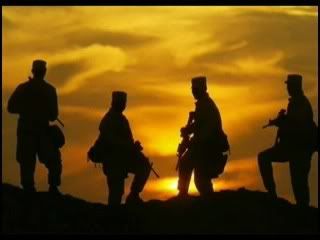
Photo of soldiers in the United States Army taken in Afghanistan in 2005 and on display at our local VFW post:

Image hosting by Photobucket
These four soldiers are home now!

The sonnet below the fold was written a few years ago by then tenth-grade homeschool student "A.M."

A Soldier’s Farewell

Belovéd, do not weep for me today,
Nor sigh on the morrow when I depart.
For though I am from thine eyes far away,
My thoughts dwell on thee as the battles start.
Death’s cold embrace might appear a relief
From this hellish battlefield’s roiling sand,
Yet then I dream my death writ on a leaf
And with renewed spirit protect my land.
I shirk not my duty to my country
And will strive to bring liberty to all;
When peace and hope shine through the night ‘round me,
Homeward shall my steps delightedly fall.
For one’s heartstrings in his own country lie
And calls him with more force than battle’s cry.
--Contributed by A.M.

More poetry, some old and some new, for this solemn day

On this Veterans Day 2010, remember to thank a veteran for his service to our nation.

Labels: , ,


Turn the page ....

Bookmark and Share
posted by Always On Watch @ 11/11/2010 06:41:00 AM  

|

Wednesday, November 11, 2009

For Veterans Day

Note to family and friends: Updates on Mr. AOW are now being added to this post.

I posted the following last year for Veterans Day and am reposting it again this year:


"The Things That Make a Soldier Great"
by Edgar Guest (1881-1959):

The things that make a soldier great and send him out to die,
To face the flaming cannon's mouth nor ever question why,
Are lilacs by a little porch, the row of tulips red,
The peonies and pansies, too, the old petunia bed,
The grass plot where his children play, the roses on the wall:
'Tis these that make a soldier great.
He's fighting for them all.

'Tis not the pomp and pride of kings that make a soldier brave;
'Tis not allegiance to the flag that over him may wave;
For soldiers never fight so well on land or on the foam
As when behind the cause they see the little place called home.
Endanger but that humble street whereon his children run,
You make a soldier of the man who never bore a gun.
What is it through the battle smoke the valiant soldier sees?

The little garden far away, the budding apple trees,
The little patch of ground back there, the children at their play,
Perhaps a tiny mound behind the simple church of gray.
The golden thread of courage isn't linked to castle dome
But to the spot, where'er it be — the humblest spot called home.
And now the lilacs bud again and all is lovely there
And homesick soldiers far away know spring is in the air;
The tulips come to bloom again, the grass once more is green,
And every man can see the spot where all his joys have been.

He sees his children smile at him, he hears the bugle call,
And only death can stop him now -- he's fighting for them all.


The following sonnet was written by then tenth-grade homeschool student "A.M." The photo of soldiers in the United States Army was taken in Afghanistan in 2005. These four soldiers are home now!

Image hosting by Photobucket


A Soldier’s Farewell

Belovéd, do not weep for me today,
Nor sigh on the morrow when I depart.
For though I am from thine eyes far away,
My thoughts dwell on thee as the battles start.
Death’s cold embrace might appear a relief
From this hellish battlefield’s roiling sand,
Yet then I dream my death writ on a leaf
And with renewed spirit protect my land.
I shirk not my duty to my country
And will strive to bring liberty to all;
When peace and hope shine through the night ‘round me,
Homeward shall my steps delightedly fall.
For one’s heartstrings in his own country lie
And calls him with more force than battle’s cry.
--Contributed by A.M.

More poetry, some old and some new, for this solemn day

On this Veterans Day 2009, remember to thank a veteran for his service to our nation.

Labels: , ,


Turn the page ....

Bookmark and Share
posted by Always On Watch @ 11/11/2009 07:41:00 AM  

|

Tuesday, November 11, 2008

For Veterans Day


"The Things That Make a Soldier Great"
by Edgar Guest (1881-1959):

The things that make a soldier great and send him out to die,
To face the flaming cannon's mouth nor ever question why,
Are lilacs by a little porch, the row of tulips red,
The peonies and pansies, too, the old petunia bed,
The grass plot where his children play, the roses on the wall:
'Tis these that make a soldier great.
He's fighting for them all.

'Tis not the pomp and pride of kings that make a soldier brave;
'Tis not allegiance to the flag that over him may wave;
For soldiers never fight so well on land or on the foam
As when behind the cause they see the little place called home.
Endanger but that humble street whereon his children run,
You make a soldier of the man who never bore a gun.
What is it through the battle smoke the valiant soldier sees?

The little garden far away, the budding apple trees,
The little patch of ground back there, the children at their play,
Perhaps a tiny mound behind the simple church of gray.
The golden thread of courage isn't linked to castle dome
But to the spot, where'er it be — the humblest spot called home.
And now the lilacs bud again and all is lovely there
And homesick soldiers far away know spring is in the air;
The tulips come to bloom again, the grass once more is green,
And every man can see the spot where all his joys have been.

He sees his children smile at him, he hears the bugle call,
And only death can stop him now -- he's fighting for them all.


The following sonnet was written by then tenth-grade homeschool student "A.M." The photo of soldiers in the United States Army was taken in Afghanistan in 2005. These four soldiers are home now!

Image hosting by Photobucket


A Soldier’s Farewell

Belovéd, do not weep for me today,
Nor sigh on the morrow when I depart.
For though I am from thine eyes far away,
My thoughts dwell on thee as the battles start.
Death’s cold embrace might appear a relief
From this hellish battlefield’s roiling sand,
Yet then I dream my death writ on a leaf
And with renewed spirit protect my land.
I shirk not my duty to my country
And will strive to bring liberty to all;
When peace and hope shine through the night ‘round me,
Homeward shall my steps delightedly fall.
For one’s heartstrings in his own country lie
And calls him with more force than battle’s cry.
--Contributed by A.M.

More poetry, some old and some new, for this solemn day

Labels: , ,


Turn the page ....

Bookmark and Share
posted by Always On Watch @ 11/11/2008 04:00:00 AM  

|

Monday, November 12, 2007

Veterans Day: Frank W. Buckles

Photo credit

Veterans Day is not about any one man or woman. Nevertheless, Frank W. Buckles is worth reading about.

This complete article in the November 12, 2007 edition of the Washington Post (emphases mine):
One by one, members of the small crowd on a hilltop at Arlington National Cemetery approached the man who had beaten all the odds.

Some saluted him. Others shook his hand, had their pictures taken with him or patted him on the back, as if touching one of the last surviving veterans of World War I would be like touching history itself.

Frank W. Buckles, 106, knows the feeling. Having lived through the Great War and imprisonment in a Japanese camp in the Philippines during World War II, Buckles said his most vivid memory from those years was meeting Gen. John J. "Blackjack" Pershing after World War I.

"He noted that we both had the same Missouri accent," Buckles recalled with a laugh. Buckles told the general that he had been raised near Bethany, Mo., and the general replied: "That's 40 miles as the crow flies from where I was born."

Yesterday, Buckles's service was honored in a Veterans Day ceremony to remember Pershing, who commanded U.S. forces in World War I. The ceremony at Pershing's grave, organized by the Military Order of the World Wars, was one of several in the area as crowds converged on the Vietnam Veterans Memorial and smaller groups gathered at various statues and memorials.

In Section 34 of the cemetery, where Pershing was buried on a rise overlooking the graves of men he led, organizers honored Buckles as one of three known surviving U.S. World War I veterans.

Sitting in a wheelchair with a military field cap on his head and a heavy blanket across his lap, Buckles recalled lying about his age to a Marine recruiter at a fair in Kansas to enlist when he was 16. On his arrival in France, he said, he was touched by the sight of so many people wearing black armbands in memory of loved ones who had already died.

Asked what he thought about attending a service for his duty while the United States is engaged in armed conflict in Iraq and Afghanistan, Buckles replied: "I'm no authority, but I'm not in favor of war unless it's an emergency."

As a teenager, Buckles was eager to enlist. He had been raised on a farm and took a job at a bank in Oklahoma after delivering some horses there. After the Marines rejected him as too young and the Navy told him he had flat feet, he signed on with the Army, claiming that Missouri did not print birth certificates when he was born. He enlisted Aug. 14, 1917.

Eager to see action, he joined an ambulance corps and sailed to Europe on the Carpathia, the ship that had rescued survivors from the Titanic in 1912. He never did make it to the front lines, but he saw firsthand the brutal consequences of war. His last assignment was caring for German prisoners of war, and he emerged from the war as a corporal.

He moved to Canada, where he found work as a purser on a White Star Line steamship and accepted an assignment to help expedite cargo shipments in World War II. He was in Manila when the city fell to the Japanese and spent three years and two months in Japanese camps.

Conversing, especially on a raw November afternoon, has become difficult for Buckles, who has a hearing aid in each ear. When taps sounded yesterday during the annual ceremony, Buckles lifted his right hand, his fingers not quite able to straighten, in a salute. Then his daughter, Susannah Flanagan, turned his wheelchair so that he could see the military representatives of several nations, including France, Canada and the United Kingdom, lay wreaths at Pershing's grave.

Asked what he credited for so long a life, Buckles said exercise was important, noting that he had kept up a daily habit of calisthenics even during his imprisonment by the Japanese.

He added: "The desire to live. To survive."
Frank W. Buckles: a living symbol of a long-ago war and of American patriotism.

Labels: , , ,


Turn the page ....

Bookmark and Share
posted by Always On Watch @ 11/12/2007 07:44:00 AM  

|